

A Comprehensive Analysis of the U.S. Economy: Insights from GDP and Its Components
The United States economy, being the largest globally, serves as a crucial indicator for international economic health.

Download the source code and dataset at the end of the article!
Its performance not only influences domestic prosperity but also affects global markets, trade dynamics, and geopolitical relationships. Understanding the complexities of the U.S. economy is essential for policymakers who craft fiscal and monetary strategies, businesses that make investment decisions, and individuals who plan their financial futures.
Gross Domestic Product (GDP) stands as a critical metric that encapsulates the total economic output of a country. It represents the monetary value of all finished goods and services produced within a nation's borders over a specific period. By analyzing GDP and its various components, we gain valuable insights into the economy's strengths, weaknesses, and growth trajectory.
In this comprehensive analysis, we delve into the components of GDP—consumer spending, investment, government expenditure, and international trade. By examining recent data and trends from the provided dataset, which includes annual and quarterly figures from 2020 to 2024, we aim to unravel the complex interplay between these factors and their real-world implications. Our goal is to equip readers with a nuanced understanding of the U.S. economy, highlighting how each GDP component contributes to overall growth. This knowledge is crucial for making informed decisions, whether in crafting economic policies, strategizing business investments, or managing personal finances.
Overview of GDP Growth
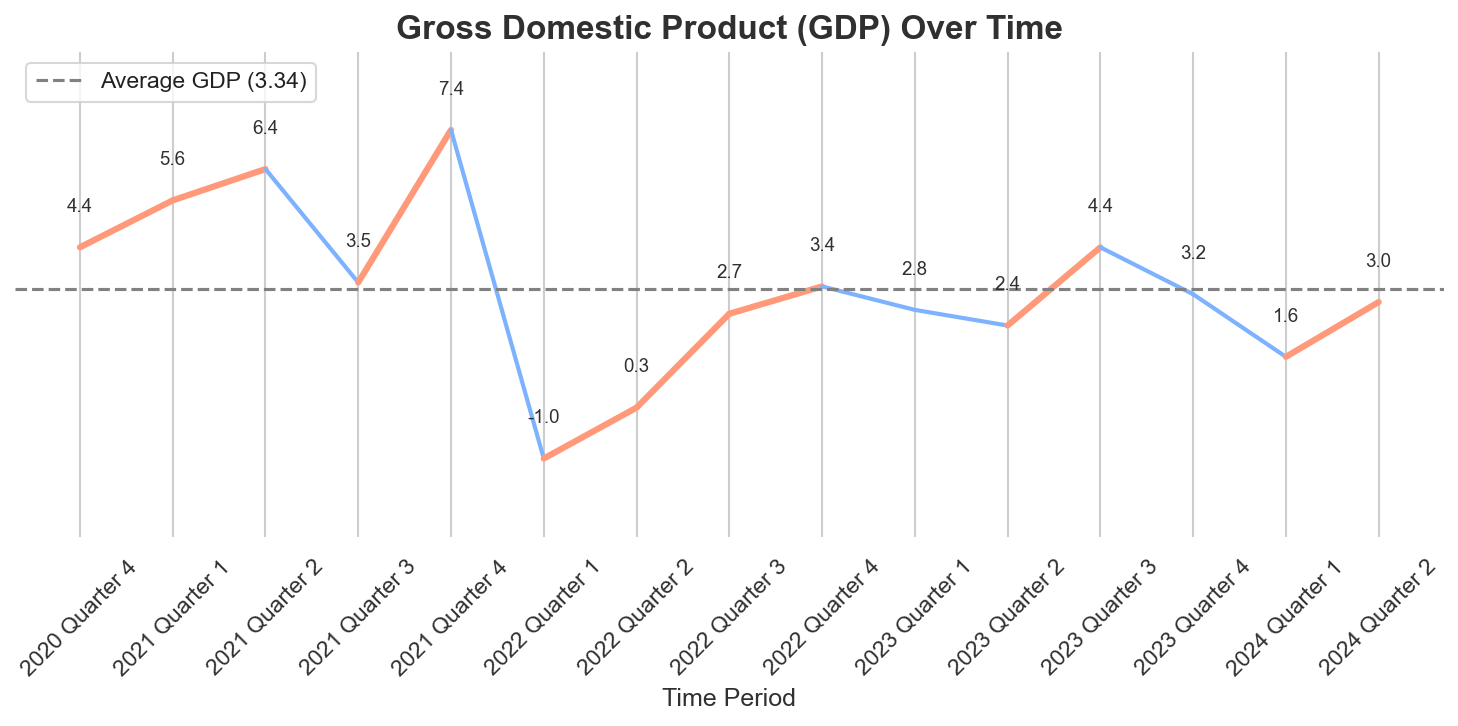
The "Gross Domestic Product (GDP) Over Time" chart illustrates the fluctuations and trends in the U.S. economy from 2020 through the projected figures in 2024. The annual GDP growth rates reveal a robust recovery from the economic contraction experienced during the height of the COVID-19 pandemic in 2020. In 2021, the economy grew by 6.1%, a significant rebound reflecting the easing of lockdowns and the impact of fiscal stimulus measures. The growth rate slowed to 2.5% in 2022, indicating a normalization of economic activities and the fading effects of initial recovery efforts. The projected growth for 2023 is 2.9%, suggesting a steady but moderate expansion.
The quarterly data provide a more granular view of the economy's performance. In the third quarter of 2020, GDP surged by 35.2%, a remarkable rebound following drastic declines due to pandemic-induced lockdowns. This surge was partly due to the low base effect from the previous quarter's contraction and the reopening of businesses. Throughout 2021, quarterly growth rates ranged from 3.5% to 7.4%, reflecting ongoing recovery efforts and the gradual return to pre-pandemic economic activities. In 2022, the economy experienced mixed performance, with a slight dip of -1.0% in the first quarter but overall positive growth, culminating in a 3.4% increase in the fourth quarter. The first two quarters of 2023 continued this trend, with growth rates of 2.8% and 2.4%, respectively.
These fluctuations underscore the economy's sensitivity to external shocks, policy decisions, and global events. The sharp decline during the pandemic and the subsequent rebound highlight the importance of responsive fiscal and monetary policies in stabilizing the economy. In real-world terms, GDP growth directly affects employment, income levels, and living standards. Higher GDP growth typically leads to job creation, reducing unemployment rates and often resulting in wage growth and increased household incomes. Sustained GDP growth can improve access to goods and services, enhancing the overall quality of life. Conversely, periods of sluggish or negative GDP growth can lead to job losses, decreased consumer spending, and economic instability.
Consumer Spending and Its Impact
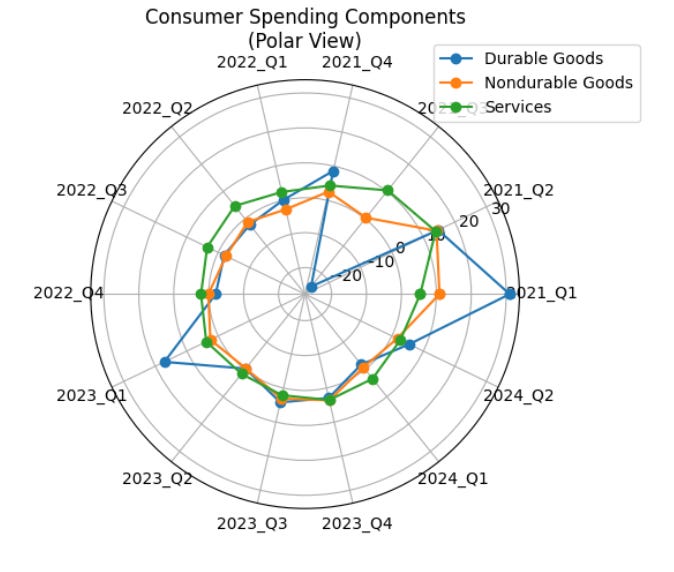
Consumer spending, also known as personal consumption expenditures (PCE), is a critical driver of the U.S. economy, accounting for approximately two-thirds of GDP. The dataset shows that in 2021, consumer spending grew by 8.8%, reflecting strong consumer confidence and the impact of government stimulus checks. This growth slowed to 3.0% in 2022 as the effects of stimulus measures waned and consumers adjusted to post-pandemic realities. The projected growth for 2023 is 2.5%, indicating steady but moderated consumer spending.
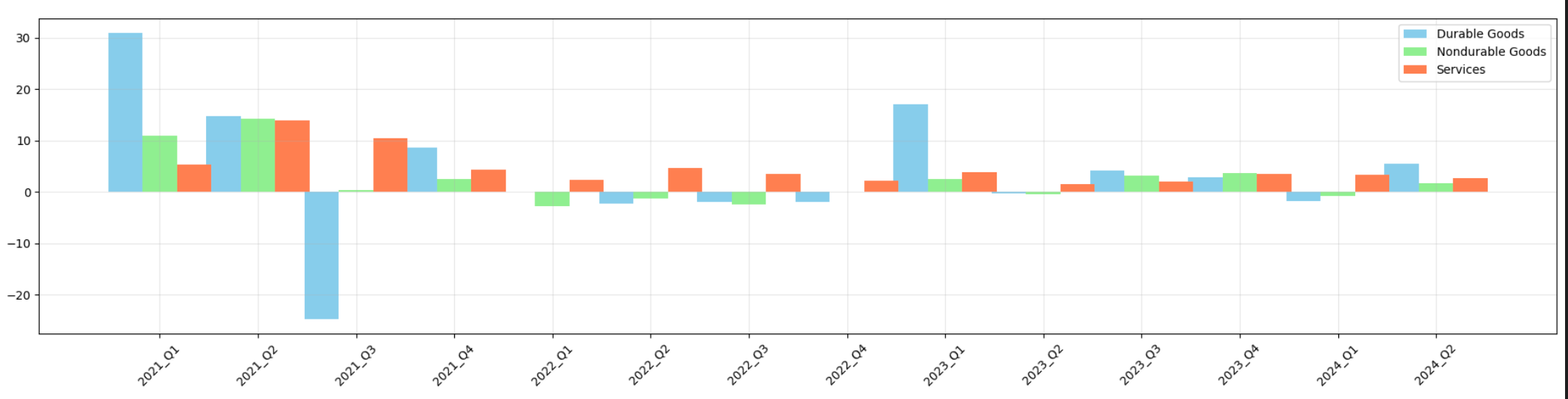
Breaking down consumer spending into its components provides deeper insights. Goods consumption, which includes both durable and nondurable goods, increased by 11.3% in 2021 but saw a slight decrease of 0.6% in 2022. The projected growth for 2023 is 1.9%. Within goods, durable goods—items expected to last three years or more—experienced significant growth of 16.6% in 2021, driven by pent-up demand and stimulus-fueled purchases of items like automobiles and appliances. However, durable goods spending declined by 1.9% in 2022 as the initial surge subsided, with a projected increase of 3.9% in 2023.
Nondurable goods, which include items like food and clothing, grew by 8.6% in 2021 and saw a slight increase of 0.1% in 2022. The expected growth for 2023 is 0.8%, suggesting stability in essential consumer spending. Services consumption, which forms the largest portion of consumer spending, showed steady growth. In 2021, services grew by 7.5%, increasing to 5.0% in 2022, with a projected growth of 2.9% in 2023. The growth in services reflects the reopening of the economy, increased mobility, and the resumption of activities like travel and dining out.
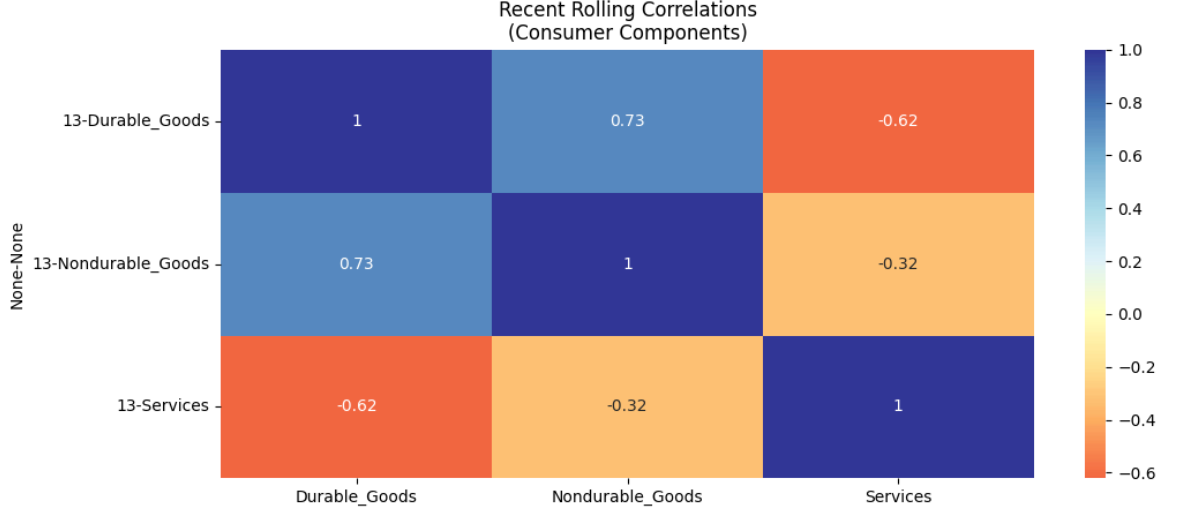
The "Rolling Correlation Evolution" and "Consumer Spending Components Comparison" charts provide visual representations of the shifting relationships between spending on durable goods, nondurable goods, and services. For instance, during economic uncertainty, consumers may delay purchases of durable goods, focusing instead on essential nondurable goods and services. The surge in durable goods in 2021 can be attributed to government stimulus payments and the release of pent-up demand following lockdowns.
Consumer spending directly impacts businesses and the broader economy. Increased consumer spending boosts demand for products and services, prompting businesses to expand operations and hire more employees. Higher revenues can lead to increased investments in innovation and productivity enhancements. Conversely, a decline in consumer spending can result in excess inventory, reduced production, and workforce reductions, leading to higher unemployment and potentially exacerbating economic downturns. Policymakers closely monitor consumer spending trends to adjust interest rates and implement fiscal policies aimed at stimulating economic activity and maintaining consumer confidence.
Investment and Its Role in Economic Growth
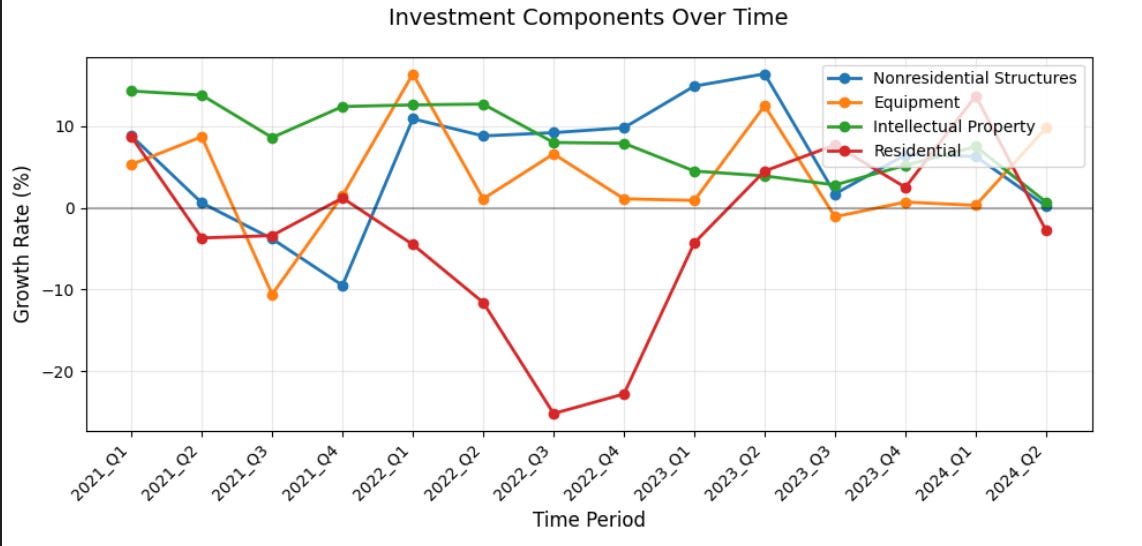
Investment, or gross private domestic investment, is essential for long-term economic growth. It encompasses business expenditures on capital goods, residential construction, and changes in inventories. The dataset indicates that investment grew by 8.8% in 2021, reflecting businesses' optimism and expansion efforts following the pandemic-induced slowdown. In 2022, investment growth remained robust at 6.0%, but the projected growth for 2023 is a marginal 0.1%, suggesting caution among businesses amid economic uncertainties.
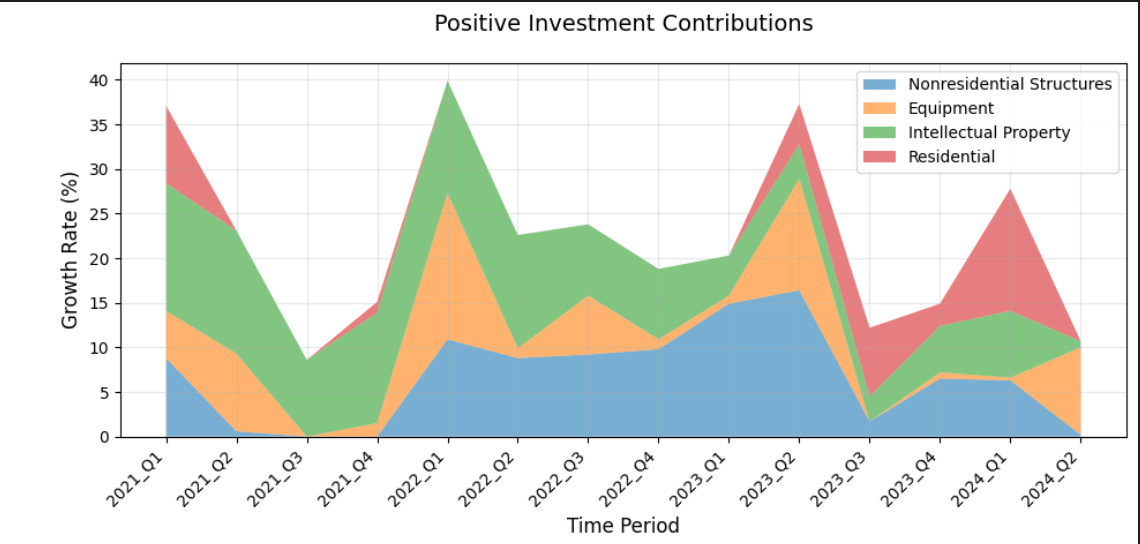
Breaking down investment into its components provides a clearer picture. Fixed investment, which includes nonresidential and residential investment, grew by 7.3% in 2021 but slowed to 2.7% in 2022, with an expected growth of 2.4% in 2023. Nonresidential investment, covering structures, equipment, and intellectual property products, showed consistent growth. It increased by 6.0% in 2021 and accelerated to 7.0% in 2022, with a projected growth of 6.0% in 2023. This growth reflects businesses investing in expanding their productive capacities and embracing new technologies.
Within nonresidential investment, structures declined by 2.6% in 2021 but increased by 3.6% in 2022. A significant growth of 10.8% is projected for 2023, indicating a potential construction boom and increased investment in commercial real estate and infrastructure. Equipment investment grew by 6.7% in 2021 but slowed to 4.4% in 2022, with a projected growth of 3.5% in 2023. Investment in intellectual property products remained robust, with a growth of 10.2% in 2021, accelerating to 11.2% in 2022, and an expected growth of 5.8% in 2023. This underscores the importance of innovation and technology in driving economic growth.
Residential investment, which includes new housing construction and improvements, showed notable growth of 10.9% in 2021, driven by low interest rates and strong housing demand. However, it declined by 8.6% in 2022 and is projected to decrease by 8.3% in 2023. This decline may be attributed to rising interest rates, increased construction costs, and a potential cooling of the housing market.
