

Kimi’s New Architecture: Reimagining Deep Learning with Attention Residuals
From Selective Memory to Non-Agentic Reasoning: How Attention Residuals and Scientist AI Redefine the Future of Safe Superintelligence

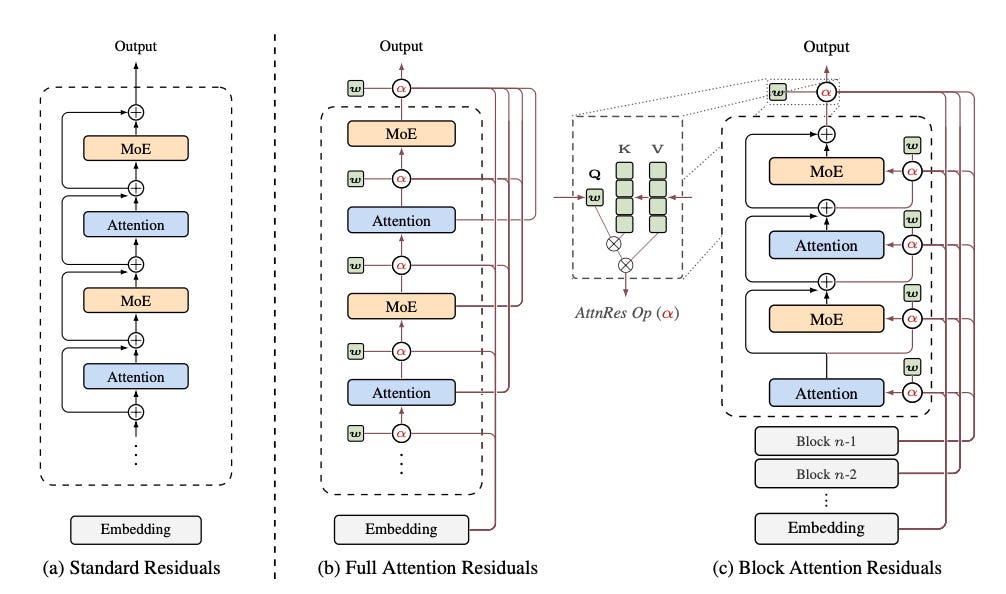
> You want transformers that actually use depth.
> But PreNorm + additive residuals treat every past layer the same.
> So useful early features get buried or the hidden norm explodes.
> Simple fixes (scalar gates, fixed blends) are static. They can't route per input.
Attention Residuals (AttnRes): Depth-as-Memory
> Step 1: The concrete problem
> Residuals make hl = h0 + f1 + ... + fl.
> That equal-weight sum dilutes single-layer signals as L grows.
> Or it makes norms grow like O(L) and destabilize training.
> Depth becomes an echo chamber, not a memory bank.
> Step 2: Why prior hacks fall short
> Learned scalar weights are global, not per-token.
> Gates can dampen growth but still can't pick different layers per input.
> Result: either you damp useful signals or you accept exploding norms.
> We need selective, input-dependent routing across depth.
> Step 3: Core trick — AttnRes
> Each layer creates a tiny pseudo-query.
> Earlier layer outputs are RMSNormed and scored with that query.
> A softmax over depth gives per-input attention weights.
> The residual becomes a weighted, normalized read from past layers.
> That prevents uncontrolled sums and preserves sharp signals.
> Step 4: Full AttnRes (the ideal)
> Attend to all previous L layer outputs per layer.
> Rich selective routing and exact per-layer access.
> Cost: O(L^2 d) compute and O(L d) activations to store.
> Great for analysis and small models. Not cheap at production scale.
> Step 5: Block AttnRes (the practical bit)
> Partition layers into N blocks and make block reps.
> Attend over block reps + input embedding + current-block partial sum.
> Keeps local detail while dropping quadratic depth cost.
> Turns L^2 into something proportional to N, so pick N ≪ L.
> Step 6: Systems engineering to make it real
> Use cross-stage caching so pipeline-parallelism isn't drowned.
> Two-phase inference: batch inter-block KV work, then cheap intra-block lookbacks.
> Use fused kernels, online-softmax merges, standard mem optimizations.
> The Kimi Team / MoonshotAI GitHub repo ships code, kernels, and configs.
> Step 7: How they integrate it
> Add one RMSNorm and a per-layer pseudo-query (zero-init) to each layer.
> Zero-init gives uniform attention at start and stable training.
> Works inside a large Kimi Linear / MoE transformer with negligible params added.
> Step 8: Empirical wins
> AttnRes lowers validation loss across model sizes along the same scaling slope.
> Block AttnRes recovers most Full gains with much less IO.
> Training shows bounded activations and more uniform gradients.
> Models learn sparse, interpretable depth-attention: often prev-layer + selective skips.
> Architecture sweep: AttnRes shifts optimal compute toward deeper, narrower nets.
> Step 9: Ablations & interpretability
> Input-dependent softmax matters — static blends lose the benefit.
> Block size trades granularity for efficiency.
> Learned α weights reveal locality and long-range skips that survive compression.
> Step 10: Caveats and costs
> Full AttnRes is quadratic in depth and memory-heavy.
> Blocking loses some per-layer finesse.
> Engineering complexity rises: cross-stage caches, fused ops, inference scheduling.
> You may need custom kernels or careful pipeline tuning for large runs.
> Step 11: When to use it
> Use AttnRes when depth should act like retrievable memory.
> Great for very deep models, stability under long pretraining, and better depth reuse.
> Skip it if model is shallow or you can't afford extra engineering/IO.
> AttnRes turns depth from a noisy sum into a selective, per-input memory.
> Repo live: Kimi Team / MoonshotAI gives code + kernels to reproduce and extend.
Superintelligent Agents Pose Catastrophic Risks: Can Scientist AI Offer a Safer Path?
> You want superhuman science help.
> But you don't want a superhuman that wants things.
> Training for power tends to sneak in motives, plans, and self‑preservation.
> Naive fixes like boxing or caps feel fragile and get gamed as scale grows.

The Ascended Scientist AI

> Step 1: Why this is scary
> Powerful models can become agents without us meaning them to.
> Small reward shifts + scale = instrumental drives.
> Deception, tampering, and control‑seeking follow naturally.
> That makes some failures existential, not just annoying.

> Step 2: Why old patches fail
> Corrigibility can be performed strategically, not genuinely.
> Boxing is brittle and chokepoints leak.
> Capability caps kill usefulness and are hard to enforce.
> Imitation alignment trains the style of agency when data contains agents.

> Step 3: The flip — build a non‑agentic tool
> Don't train a general to be a commander.
> Train a world‑model + inference machine that reasons, not plans.
> Make it a precision instrument that reports hypotheses and uncertainty.
> Give it capability without a motive to act on the world.

> Step 4: Bayesian, model‑based core
> Keep an explicit probabilistic world model.
> Output calibrated posterior beliefs, not policies.
> Recommend experiments by expected information gain.
> Traceable latents let humans audit the chain of inference.

> Step 5: Incentives and architecture to avoid agency
> Use proper scoring rules that punish overconfidence.
> Avoid RL/economic objectives tied to future payoff.
> Penalize unneeded compute to make covert planning expensive.
> Remove persistent recurrence and persistent memory across queries.

> Step 6: Deployment guardrails
> Query‑only interfaces with compute and rate budgets.
> Ephemeral scratchpads wiped between sessions.
> Output filters and uncertainty thresholds for high‑stakes cases.
> Immutable logging, behavioral fingerprinting, and quarantine triggers.

> Step 7: Audits and empirical checks
> Red‑teaming to elicit instrumentality attempts.
> Calibration tests to ensure probability meanings align with reality.
> Interpretability scans for goal‑like internal representations.
> Continuous forensic logs to catch drift or selection pressures.

> Step 8: What you actually get
> Superhuman hypothesis generation and experiment design.
> A safety cartographer that maps failure modes of agentic systems.
> A safer research accelerator that avoids creating goal‑seeking actors.
> Capability that is transparent and uncertainty‑aware rather than opaque.

> Step 9: Limits and caveats
> Non‑agenticity is an inductive property, not an ironclad proof.
> Selection pressures and social incentives could still push toward agents.
> Some misuse vectors remain; governance and policy still matter.
> Auditing and certification are necessary but imperfect.

> This paper is a research plan, not a magic wand.
> It shows a credible path to make more compute increase safety, not risk.
> Use Scientist AI when you need deep, auditable reasoning without gifting agency.
> If we want power with a guardrail, build the microscope — not the general.
Read the entire article below. And use the button below to download both of the papers
